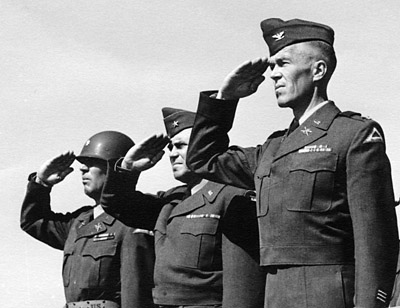
John Honeycutt was born in New York into a family firmly grounded in the rich traditions of the United States Army. After graduating 19th in a class of 346 from the U.S. Military Academy
at West Point in 1933 as a 2nd Lieutenant in the field artillery,
he partook of a legacy that includes not only his father and grandfather but more than two dozen other relatives.
General Honeycutt's 40 years of service to his country took him around the world in a variety of capacities, and after duty
in North Africa in World War II,
he was assigned to posts as diverse as Korea, Paris, and the Pentagon. He also taught mathematics at West Point and founded the Sandia Base Atomic Museum in
Albuquerque, New Mexico, before retiring as a two-star major general in 1969. His final tour of duty was as DASA Field Commander at Sandia Base in Albuquerque.
On leaving military service, General Honeycutt was free to pursue both his love of fine music and his skill as a woodworker; these avocations found full
expression in his devotion to the art of violin-making. Although largely self-taught, General Honeycutt did study with
Ed Campbell, a violin maker in Pennsylvania.
In the years that followed he crafted 63 instruments, including one played by his beloved wife Esther in the New Mexico Symphony Orchestra before her retirement in 2001. General Honeycutt passed away in January of 1996 and Esther in June of 2011.
Here's an excerpt from a web site by his son-in-law, Dr. Bruce A. Stafford:
"One of the biggest inspirations in my life - Major General John T. Honeycutt, USMA class of 1933 died two weeks after I had the pleasure of toasting his undying
confidence and telling him of my acceptance into medical school. The general had encouraged me to keep plugging away as he had done until he met his end. After
retiring from the Army he took up his love of making violins.
"He became a master violin maker and, though he did not live long enough to make the 100 he had set out to make, he did produce over 60 beautiful instruments.
He had been stricken with a Staph infection which triggered a latent, rare genetic disorder involving the neuromuscular system. The last several years while he
lay pretty much bedridden he took up the study and review of the calculus to refresh himself with a subject he had once taught at West Point. He refused to
allow his mind to rest even though his body was unresponsive in the end.
"I will never forget you general, thanks for your undying support. I know you are with me in spirit."